 EN
EN

Cotton Fiber Quality: The Critical Base for Premium Indigo Denim
Staple Length, Strength, and Fineness as Key Indigo Denim Performance Indicators
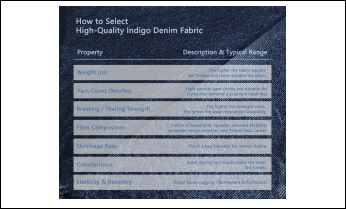
The foundation of premium indigo denim begins at the fiber level. Cotton staple length directly determines yarn evenness and fabric strength; fibers measuring 1.2 inches or longer produce smoother, more durable yarns with fewer weak points. Fiber strength—measured in grams per tex—ensures yarns withstand the mechanical stresses of weaving and garment construction. Fineness, expressed as micronaire, affects how tightly fibers can be twisted, influencing both fabric density and hand feel. Together, these three metrics dictate structural integrity and aesthetic potential. For consistent performance across dyeing, finishing, and production, garment manufacturers should specify cotton with a minimum staple length of 1.18 inches, strength above 28 g/tex, and a micronaire range of 3.8 to 4.5.
Long-Staple vs. Upland Cotton: Impact on Indigo Dye Uptake, Fade Character, and Fabric Hand
The choice between long-staple and upland cotton fundamentally shapes indigo denim quality. Long-staple varieties—such as Egyptian Giza or American Pima—produce yarns with fewer protruding fiber ends, yielding a smoother surface that promotes even indigo dye uptake and deeper, more uniform color. This tight fiber alignment also supports slower, higher-contrast fading and a luxurious hand feel. In contrast, upland cotton’s shorter fibers create slightly rougher yarns with more surface nap, accelerating initial dye absorption but resulting in faster, less predictable fade patterns. Its stiffer initial hand softens gradually over time. For premium indigo denim where fade character and tactile refinement are key differentiators, long-staple cotton justifies its premium cost through superior dye consistency and more controlled aging behavior.
Yarn Construction: Optimizing Strength, Texture, and Indigo Locking for Denim Durability
Ring-Spun vs. Open-End Yarns: Tensile Integrity, Surface Napping, and Indigo Denim Fade Consistency
Yarn construction critically influences denim’s durability and visual evolution. Ring-spun yarns—formed by twisting fibers under tension—deliver higher tensile strength, greater surface napping, and a softer hand. These characteristics enhance indigo dye penetration and support the gradual, even fading prized in premium denim. Open-end yarns, produced via a faster, more economical process, yield a smoother, harder yarn with reduced twist integrity. While cost-effective, they offer lower tensile strength, less surface texture, and diminished capacity for indigo to lock into the yarn core—leading to quicker, less consistent fading. For brands prioritizing long-term color evolution and mechanical resilience, ring-spun yarn remains the authoritative standard.
Indigo Dyeing Process: Precision Parameters That Define Color Depth, Fastness, and Authentic Fade
Vat Dyeing Control: Reduction Efficiency, Dip Count, and Oxidation Timing in High-Performance Indigo Denim
Vat dyeing precision defines the signature depth, fastness, and fade authenticity of high-performance indigo denim. The process hinges on three interdependent parameters: reduction efficiency, dip count, and oxidation timing. Efficient reduction converts insoluble indigo into its soluble leuco form uniformly—ensuring consistent dye uptake and minimizing chemical waste. Each immersion (dip) deposits another layer of indigo onto the fiber’s outer surface, building the ring-dyed structure essential for authentic wear-induced fades. Typically, six to eight dips achieve optimal color depth without compromising fiber integrity. Oxidation then reconverts leuco-indigo to its insoluble state, locking dye into place. Too brief an oxidation results in poor washfastness; excessive exposure dulls vibrancy. Tight control across all three variables ensures repeatable color richness and reliable fade development.
Sustainable Indigo Alternatives vs. Traditional Vat Dyes: Trade-offs for Premium Indigo Denim Quality
Traditional synthetic vat dyes deliver unmatched color consistency, depth, and fade predictability—qualities rooted in decades of industrial refinement and standardized application protocols. Sustainable alternatives—including plant-derived indigo and pre-reduced natural formulations—reduce water consumption and eliminate hazardous reducing agents like sodium hydrosulfite. Yet they introduce measurable trade-offs: batch-to-batch shade variation, marginally lower color yield, and altered molecular bonding that can accelerate or homogenize fading, diminishing the nuanced contrast consumers associate with premium denim. Cost premiums remain significant. A pragmatic path forward—increasingly adopted by leading mills—is hybrid dyeing: using sustainable indigo as a foundational layer, followed by a final pass of traditional vat dye to ensure color depth, fastness, and fade fidelity aligned with premium expectations.
Weave Structure and Fabric Engineering: Twill Geometry’s Role in Indigo Denim Wear Performance
2/1 vs. 3/1 Twill, Yarn Count Balance, and Mechanical Stability in Garment-Grade Indigo Denim
Twill geometry is not merely aesthetic—it governs how indigo denim performs during cutting, sewing, and years of wear. The 3/1 twill—where the weft passes over three warp ends and under one—creates a pronounced diagonal rib that evenly distributes mechanical stress. This structure delivers superior tear strength, abrasion resistance, and resistance to seam slippage, making it the benchmark for durable, high-performance denim. The 2/1 twill, with its shorter float, yields a flatter, more pliable surface and enhanced drape—but at the expense of mechanical stability in high-flex zones like knees and seat. Yarn count balance further refines behavior: higher warp counts (e.g., Ne 7–8) paired with finer weft yarns increase stiffness and abrasion resistance, while balanced counts improve flexibility and conformability. For premium indigo denim, deliberate selection of twill type and yarn count ensures dimensional stability, authentic fade progression, and predictable washdown response across the garment’s lifecycle.
FAQ
What are the key cotton fiber qualities for premium denim production?
The essential cotton fiber qualities include a minimum staple length of 1.18 inches, strength above 28 grams per tex, and a micronaire range of 3.8 to 4.5. These metrics ensure yarn durability, structural integrity, and optimal fabric properties.
How does long-staple cotton enhance indigo denim quality?
Long-staple cotton offers smoother yarns, promoting even dye uptake and deeper, more uniform color. Additionally, its tight fiber alignment supports slower, high-contrast fading and a luxurious feel, making it ideal for premium denim products.
What is the advantage of ring-spun yarns in denim production?
Ring-spun yarns deliver higher tensile strength, enhanced surface napping, and better indigo dye penetration. These features contribute to gradual, even fading and improved durability, making it a preferred choice for premium denim.
What are the benefits of traditional vat dyeing for indigo denim?
Traditional vat dyeing ensures unmatched color consistency, depth, and fade predictability. Tight control of key parameters also provides authentic wear-induced fade effects while maintaining fabric integrity.
What is the difference between 3/1 and 2/1 twill in denim manufacturing?
3/1 twill has superior tear strength, abrasion resistance, and dimensional stability ideal for durable apparel. The 2/1 twill, while offering a softer drape, lacks the mechanical stability required for high-performance denim.
Table of Contents
- Cotton Fiber Quality: The Critical Base for Premium Indigo Denim
- Yarn Construction: Optimizing Strength, Texture, and Indigo Locking for Denim Durability
- Indigo Dyeing Process: Precision Parameters That Define Color Depth, Fastness, and Authentic Fade
- Weave Structure and Fabric Engineering: Twill Geometry’s Role in Indigo Denim Wear Performance
-
FAQ
- What are the key cotton fiber qualities for premium denim production?
- How does long-staple cotton enhance indigo denim quality?
- What is the advantage of ring-spun yarns in denim production?
- What are the benefits of traditional vat dyeing for indigo denim?
- What is the difference between 3/1 and 2/1 twill in denim manufacturing?