 EN
EN

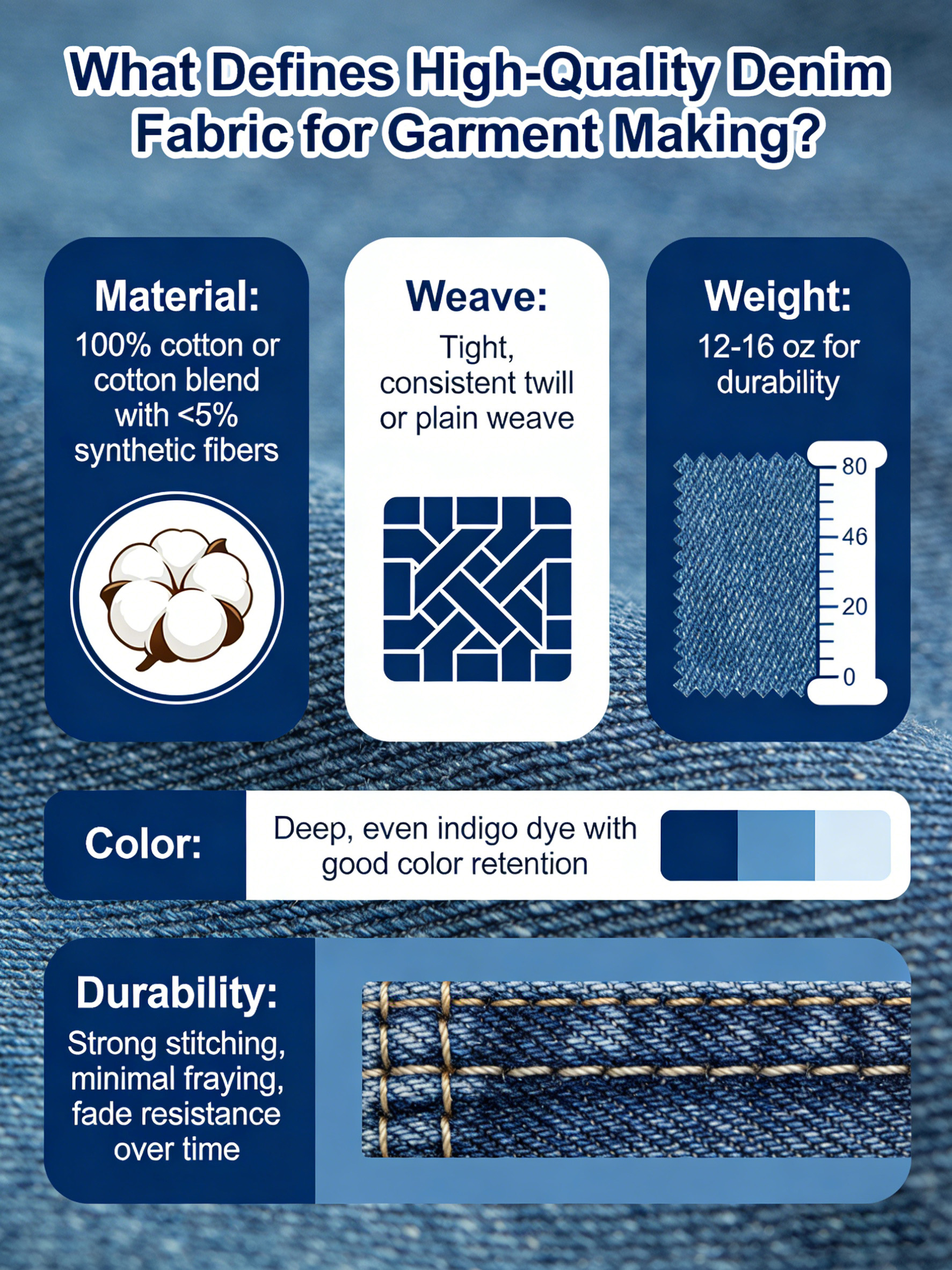
Cotton Fiber and Yarn Quality: The Foundation of Premium Denim Fabric
Long-staple cotton and ring-spun yarns: Enhancing tensile strength, softness, and surface consistency
Long-staple cotton—fibers exceeding 1.375 inches—is the cornerstone of premium denim. Its extended length delivers 25–30% greater tensile strength than shorter staples, enabling fabrics that resist tearing while retaining drape and comfort. When processed via ring-spinning, these fibers are twisted into dense, uniform yarns with tightly bound surfaces. This minimizes fiber shedding during weaving and subsequent wear, resulting in cleaner fabric faces and consistent texture. The combination yields signature softness, structural resilience across repeated wear cycles, and the gradual, authentic fading prized in luxury denim.
Core-spun vs. open-end yarns: Balancing pilling resistance, durability, and production efficiency
| Yarn Type | Pilling Resistance | Durability | Production Speed | Best Use Case |
|---|---|---|---|---|
| Core-spun | Excellent | High | Moderate | Premium denim lines |
| Open-end | Moderate | Medium | High | Mass-market production |
Core-spun yarns integrate a synthetic core—typically polyester or spandex—wrapped entirely in long-staple cotton. This structure delivers exceptional pilling resistance without sacrificing cotton’s breathability or hand feel. In contrast, open-end yarns, produced at high speed via rotor spinning, offer cost and throughput advantages but exhibit lower twist integrity and fiber cohesion. After 20+ washes, open-end denim often shows accelerated surface abrasion and seam stress, making core-spun the preferred choice for garments engineered for longevity and refined aesthetics.
Cotton-polyester-spandex blends: Evaluating stretch recovery, breathability, and long-term denim fabric integrity
Blends introduce functional benefits—but require precise formulation to preserve denim’s essential character. Polyester enhances shape retention and reduces shrinkage, while spandex contributes 25–40% stretch capacity. Yet breathability declines: pure cotton allows ~35% greater airflow than typical 98/2 cotton/spandex blends. More critically, long-term integrity hinges on spandex quality and stabilization. Low-grade elastane degrades after ~50 washes, leading to bagging and loss of recovery. Premium denim maintains ≥95% stretch recovery over 100+ washes through optimized fiber ratios (e.g., 1–2% Lycra® T400®), heat-setting during finishing, and protective coating technologies—all without compromising the natural drape or fade development expected of authentic denim.
Weave Structure and Loom Technology: Engineering Denim Fabric Performance
Selvedge Denim Fabric: Shuttle Loom Precision, Edge Stability, and Its Impact on Garment Longevity
Selvedge denim is defined by its self-finished edges—woven on traditional shuttle looms that interlock warp and weft threads tightly at the fabric’s perimeter. This creates a denser, more stable edge that resists fraying and unraveling, contributing to 15–20% higher fabric density than projectile-loom alternatives. That density translates directly to durability: seams experience less stress migration, and garment life extends significantly where edge integrity is critical—like cuff hems and pocket openings. Though slower and more labor-intensive, shuttle looms also produce subtle irregularities in tension and pick spacing, which evolve into nuanced, organic fading patterns over time—key to the authenticity sought in heritage and premium denim.
Twill Weave Variations (3/1 vs. 2/1): Effects on Drape, Abrasion Resistance, and Authentic Fading Behavior
Twill weave geometry fundamentally shapes performance. The classic 3/1 twill—three warp threads over one weft—produces a bold, raised diagonal rib that increases abrasion resistance by ~30% versus 2/1. Its heavier hand and stiffer drape suit rugged workwear applications where durability outweighs flexibility. The 2/1 variation—two warp under, one weft over—yields a lighter, more supple fabric with superior drape and conformability, ideal for contemporary fits. Fading behavior diverges accordingly: 3/1 twills accentuate vertical fading along prominent warp ridges, yielding high-contrast, directional wear; 2/1 twills promote softer, more even surface abrasion and gentler tonal transitions. Designers select based on both functional intent and the specific aging narrative they aim to support.
Dyeing Process and Colorfastness: Critical Metrics for Denim Fabric Reliability
Indigo depth, sulfur dye alternatives, and eco-dyeing methods: Trade-offs in wash-fastness and sustainability
Indigo remains the benchmark for authentic denim aesthetics—but its physical adsorption (not chemical bonding) to cotton limits wash-fastness. Deeper indigo dips increase visual richness yet accelerate crocking and wash-off, especially in raw or semi-washed fabrics. Sulfur dyes offer stronger color retention for black and navy shades but rely on heavy-metal catalysts like sodium sulfide, raising environmental and regulatory concerns. In response, eco-dyeing innovations—including foam-based indigo application and ozone bleaching—cut water use by 60–90% and eliminate toxic effluent. However, these methods demand tight control over pH, temperature, and dwell time to avoid inconsistencies in shade depth, tensile strength, or fading uniformity. Natural indigo alternatives improve biodegradability but typically achieve only ISO 105-C06 Grade 3 colorfastness—falling short of the Grade 4+ standard required for premium denim. As a result, leading mills prioritize hybrid approaches: using low-impact indigo systems with certified sustainable cotton and rigorous batch validation—ensuring both ecological responsibility and uncompromised performance.
FAQ
Why is long-staple cotton essential for premium denim?
Long-staple cotton provides 25–30% greater tensile strength, minimizes fiber shedding, and ensures a soft, durable fabric ideal for high-quality denim.
What is the difference between core-spun and open-end yarns?
Core-spun yarns offer excellent pilling resistance and durability due to their synthetic core, while open-end yarns prioritize production speed but are less durable over time.
How do cotton-polyester-spandex blends affect denim quality?
These blends improve stretch recovery and reduce shrinkage but may decrease breathability. High-quality blends ensure stretch recovery over 100+ washes without compromising denim’s natural drape.
What is selvedge denim, and why is it preferred?
Selvedge denim is woven with self-finished edges on shuttle looms, creating stable fabrics that resist fraying and provide superior durability and authenticity.
How does the dyeing process impact denim sustainability?
Traditional indigo dyeing can be resource-intensive, but innovations like foam-based applications and ozone bleaching reduce environmental impact while maintaining fabric integrity.
Table of Contents
-
Cotton Fiber and Yarn Quality: The Foundation of Premium Denim Fabric
- Long-staple cotton and ring-spun yarns: Enhancing tensile strength, softness, and surface consistency
- Core-spun vs. open-end yarns: Balancing pilling resistance, durability, and production efficiency
- Cotton-polyester-spandex blends: Evaluating stretch recovery, breathability, and long-term denim fabric integrity
- Weave Structure and Loom Technology: Engineering Denim Fabric Performance
- Dyeing Process and Colorfastness: Critical Metrics for Denim Fabric Reliability
- FAQ