 EN
EN

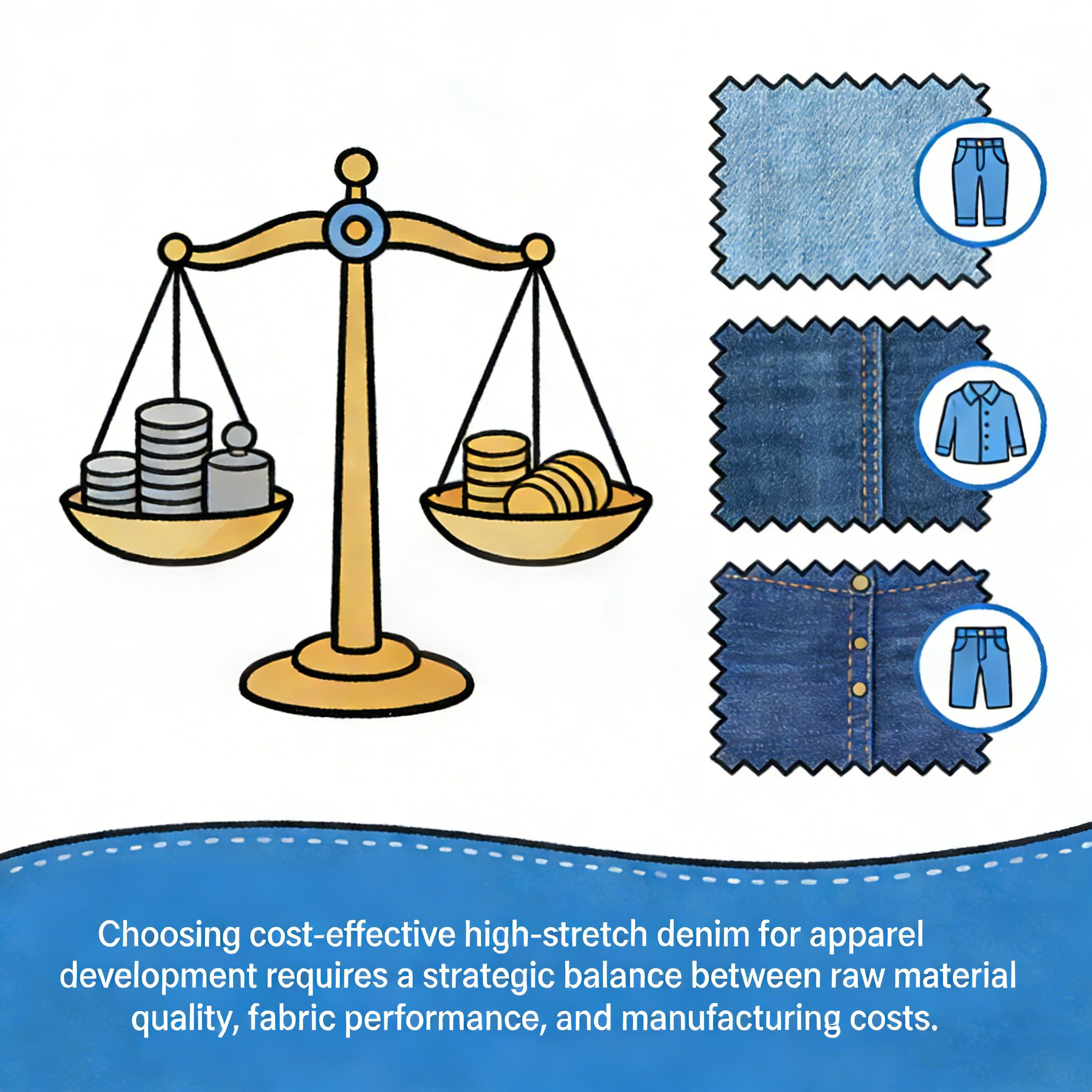
What Defines True High-Stretch Denim: Performance, Recovery, and Fabric Science
Stretch percentage, elastane content, and the 2–6% sweet spot for apparel-grade high stretch denim
True high-stretch denim relies on precise elastane integration—typically 2–6%—to deliver optimal flexibility without sacrificing structure. Below 2%, stretch is insufficient for dynamic movement; above 6%, fabric integrity and long-term shape retention decline significantly. This narrow range enables form-fitting performance while preserving durability across repeated wear and wash cycles.
Recovery mechanics: Why four-way stretch and dual-core yarns outperform basic power stretch in garment longevity
Denim with four-way stretch is made using special dual-core yarns where the elastic fibers are completely wrapped in cotton. This construction gives much better shape retention compared to regular power stretch fabrics that only stretch in two directions. When someone moves around, the fabric snaps back to its original form consistently, so those trouble spots like the knees and butt area don't sag or bag out as badly. The encapsulation technique actually protects the elastic components from getting damaged when washed, either by friction or harsh detergents. Most manufacturers find this makes their jeans last longer before they start losing their shape completely.
| Stretch Type | Movement Direction | Recovery Rate | Durability Impact |
|---|---|---|---|
| Two-Way (Power Stretch) | Vertical only | ≥70% | High knee bagging |
| Four-Way (Dual-Core) | Vertical + Horizontal | ≥90% | Minimal deformation |
This structural advantage extends garment lifespan by 40% compared to basic stretch alternatives (Textile Institute, 2023), as reinforced yarns resist fiber fatigue through daily wear cycles.
Balancing Cost and Quality: Durability, Shrinkage, and Wear Performance Trade-Offs
Cotton/elastane vs. polyester-blend high stretch denim: cost implications, pilling resistance, and dimensional stability
What materials we choose really affects what something costs and how people feel when they wear it. Cotton mixed with elastane gives great airflow and keeps bouncing back even after being washed dozens of times, holding onto around 92% of its stretchiness after half a hundred wash cycles or so. But these blends usually come at a price tag that's 15 to 25 percent higher than polyester alternatives. Polyester mixes save money and resist those annoying little balls that form on fabric surfaces, but they don't handle body heat as well and tend to sag in certain areas faster than cotton blends, even though they shrink less overall (about 2 to 4 percent compared to cotton's 4 to 7 percent). When looking at durability over time, most folks still consider cotton/elastane the gold standard for clothing, particularly when comfort matters most and things need to keep their shape wash after wash.
| Attribute | Cotton/Elastane | Polyester Blend |
|---|---|---|
| Cost per yard | Higher ($3.8–$5.2) | Lower ($2.9–$4.1) |
| Pilling Resistance | Moderate | High |
| Shrinkage Rate | 4–7% after washes | 2–4% after washes |
| Breathability | Excellent | Moderate |
Critical durability markers: abrasion resistance (Martindale), stress-point reinforcement, and post-wash recovery retention
Three measurable benchmarks define durable high-stretch denim:
- Abrasion resistance: Fabrics exceeding 40,000 Martindale cycles withstand 18+ months of daily wear.
- Stress-point reinforcement: Strategically placed bartacks at pockets and seams cut tear incidents by up to 60%.
- Recovery retention: Premium dual-core constructions retain ≥92% original stretch capacity after 20 washes; budget alternatives often degrade to 74%.
Testing must simulate real-world use—including multi-directional stretch and repeated 40°C wash cycles. Brands achieving optimal cost-quality balance specify ≥85% recovery retention and ≥30,000 Martindale scores to prevent premature failure without inflating material costs.
Key Selection Criteria for Brand Developers: Wash Resistance, Certifications, and Consistency
When picking out really good stretch denim, we need to look at more than just how much it stretches. The fabric needs to hold up through lots of washing too. Great quality denim should lose no more than 8% color after about 50 machine washes in factories. There are some important labels to watch for as well. OEKO-TEX Standard 100 means the chemicals used are safe for people who wear the jeans. Another label called GOTS checks that everything from cotton farming to final product meets environmental standards. Manufacturers also have to make sure every bolt of fabric coming off the production line looks and feels the same. That usually means getting someone independent to check their work regularly.
- Dimensional stability (≤3% shrinkage variance post-wash)
- Recovery retention (≥92% original elasticity after 5 wear/wash cycles)
- Uniformity in weight (±5 gsm tolerance) and surface texture
Brands applying these benchmarks see 30% fewer customer returns tied to fabric performance issues.
Smart Sourcing of High-Stretch Denim: Channels, Vetting, and MOQ Optimization
Factory-direct vs. denim mills vs. B2B platforms: evaluating lead time, customization flexibility, and compliance transparency
When building a sourcing strategy, it really needs to match what the brand is aiming for in terms of size and technical capabilities. Going straight to factories can be fast, but often means less help with new ideas and innovations. The specialized denim mills out there have all sorts of know-how when it comes to developing those stretchy fabrics, especially with things like dual core yarn tech, although most will want bigger minimum order quantities before they even consider working together. Online B2B marketplaces make getting samples quicker and allow for smaller test orders, but companies need to dig deep into their compliance papers first. Look for partners who actually show proof through third party audits rather than just making bold statements about quality control. Real transparency matters more than empty promises these days.
Practical vetting checklist: swatch testing protocol, lot-to-lot consistency verification, and certification alignment (OEKO-TEX®, GOTS)
Before bulk ordering, implement this three-phase vetting protocol:
- Swatch stress-testing: Assess recovery using ASTM D3107 after 50+ wash cycles.
- Production consistency audits: Compare shade, elongation, and recovery across three historical lots.
- Certification validation: Cross-check supplier-provided OEKO-TEX® STD 100 and GOTS certificates against official database entries.
Lab-validated results should show ≤8% recovery loss and ≥30,000 Martindale abrasion cycles—non-negotiable thresholds for apparel-grade durability.
FAQ
What is the ideal elastane content for high-stretch denim?
For optimal flexibility and fabric integrity, the ideal elastane content in high-stretch denim is between 2% and 6%.
Why are dual-core yarns preferred over power stretch fabrics?
Dual-core yarns provide better shape retention and recovery compared to power stretch fabrics, as they are wrapped in cotton, which protects the elastic fibers and prolongs the garment's lifespan.
What are the benefits of cotton/elastane blends over polyester blends?
Cotton/elastane blends offer superior breathability and maintain their shape better through washes, although they are generally costlier than polyester blends.
How can durability be measured in high-stretch denim?
Durability can be assessed by abrasion resistance (Martindale cycles), stress-point reinforcement, and recovery retention after washes, aiming for specific benchmarks like ≥30,000 Martindale cycles.
Table of Contents
- What Defines True High-Stretch Denim: Performance, Recovery, and Fabric Science
- Balancing Cost and Quality: Durability, Shrinkage, and Wear Performance Trade-Offs
- Key Selection Criteria for Brand Developers: Wash Resistance, Certifications, and Consistency
- Smart Sourcing of High-Stretch Denim: Channels, Vetting, and MOQ Optimization
- FAQ