 EN
EN

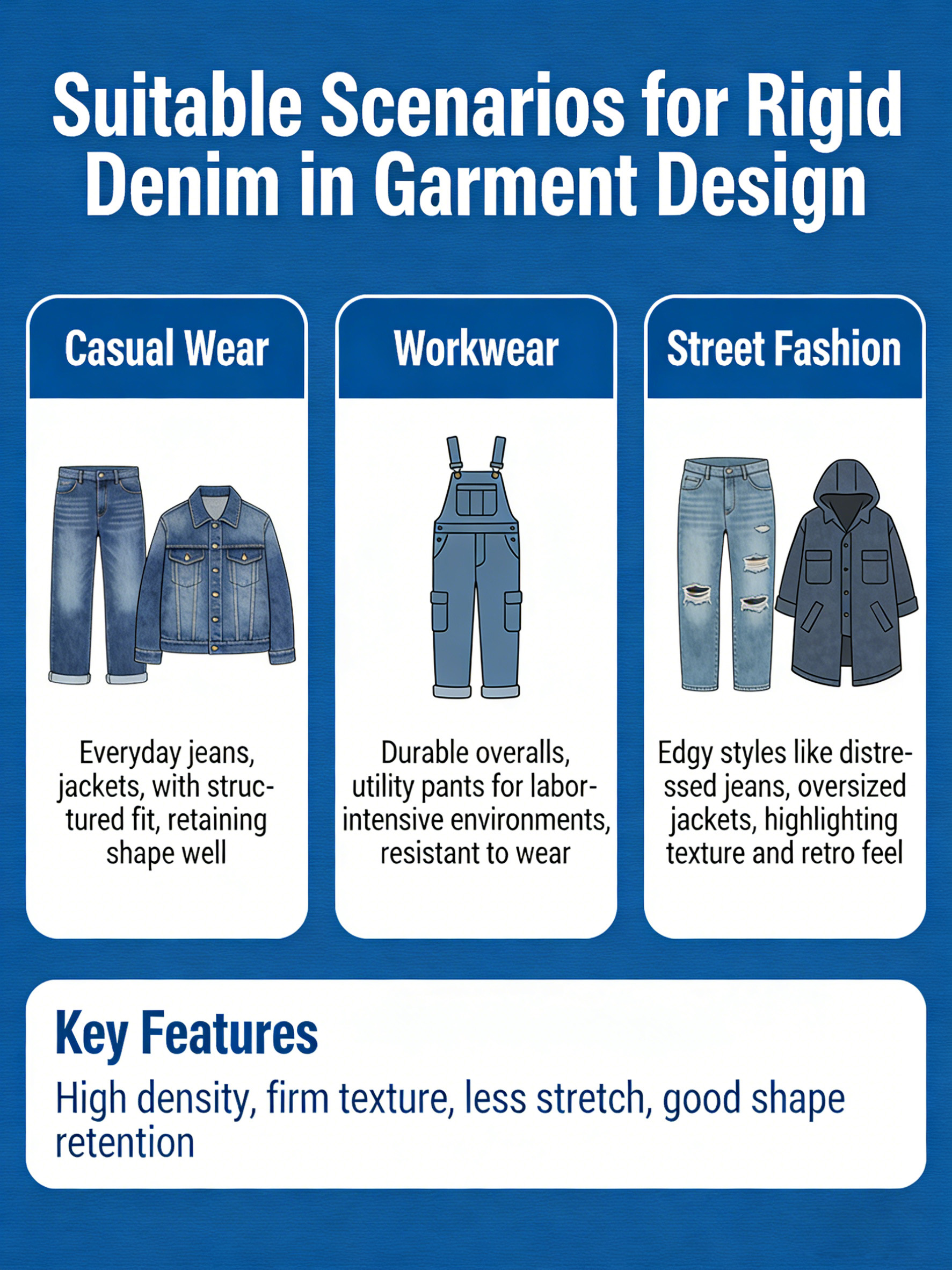
Core Properties of Rigid Denim That Define Its Design Utility
100% Cotton Twill Weave and Selvedge Construction for Structural Integrity
Rigid denim’s foundation is a 100% cotton twill weave—its diagonal rib structure delivers inherent tensile strength and abrasion resistance, especially critical in high-stress zones like knees, seams, and pockets. Paired with selvedge construction—a self-finished, tightly woven edge—the fabric resists fraying during cutting, sewing, and long-term wear. This dual structural advantage enables clean, precise tailoring in garments such as raw-denim jeans and structured jackets, where edge integrity directly impacts longevity and aesthetic fidelity.
Weight Range (10–15 oz/yd²) and How It Supports Shape Retention
Rigid denim’s functional versatility centers on its 10–15 oz/yd² weight spectrum. At the heavier end (14–15 oz), the fabric delivers exceptional shape retention under load—ideal for chore coats and workwear that must hold a boxy, architectural profile season after season. Mid-weights (12–13 oz) offer a refined balance: sufficient body to sustain sharp drape and crease definition in tailored shirts and trousers, without compromising mobility. Unlike lighter or stretch-blend denims, this density minimizes sagging, bagging, or distortion over time—ensuring the garment’s intended silhouette remains intact through repeated wear and laundering.
Zero-Stretch Fabric Behavior and Natural Break-In as Intentional Design Leverage
With zero elasticity, rigid denim demands exacting pattern engineering—but that constraint is foundational to its design value. Rather than resisting fit, designers leverage its stiffness as a starting point for personalized evolution. Over 30–90 wears, the fabric gradually conforms to the wearer’s movement patterns, softening at stress points and developing signature creases—whiskering at the hips, honeycombs behind the knees—that become unique markers of use. This controlled break-in transforms each garment into a custom-fit artifact, aligning durability with narrative depth. Heritage brands, in particular, treat patina not as wear-and-tear but as intentional aesthetic storytelling rooted in material authenticity.
Rigid Denim in Tailored Fit Development and Body-Contouring Silhouettes
Rigid denim’s combination of zero-stretch behavior, medium-to-heavy weight (10–15 oz/yd²), and structural stability makes it uniquely suited for precision tailoring. Its resistance to deformation allows patternmakers to draft with confidence—knowing that initial sharpness will evolve into lasting, body-hugging contours rather than collapse. This predictability supports architectural designs such as high-waisted trousers with permanent center-front creases, streamlined jackets with defined shoulder lines, and precision-cut jeans that retain crisp seam integrity. Unlike stretch alternatives—which rely on synthetic fibers to recover shape—rigid denim achieves long-term form retention through natural fiber memory and progressive molding, delivering refined aesthetics anchored in functional durability.
Rigid Denim for High-Durability Workwear and Structured Outerwear
The dense twill weave and 10–15 oz/yd² weight of rigid denim deliver exceptional toughness—making it a benchmark for high-abrasion workwear in construction, agriculture, and manufacturing. Its resistance to tearing, pilling, and edge fraying extends garment lifespan significantly; field data from industrial apparel suppliers indicates up to three times longer service life compared to lightweight cotton twills. In outerwear, rigid denim eliminates the need for internal interfacing while maintaining crisp silhouettes—chore coats and utility jackets hold their shape across dozens of wears without buckling or slumping. Crucially, its controlled break-in process ensures that early stiffness gives way to personalized comfort without sacrificing structural integrity—a rare convergence of resilience and adaptive fit that informs both functional and aesthetic decisions.
| Application | Key Benefit of Rigid Denim | Performance Outcome |
|---|---|---|
| Heavy-duty workwear | Abrasion resistance (10–15 oz weight) | 3X longer lifespan vs. lightweight fabrics |
| Structured jackets | Shape retention without interfacing | Maintains silhouette after 50+ wears |
| Reinforced trousers | Tear resistance at stress points | Withstands kneeling/crouching motions |
Design Considerations When Specifying Rigid Denim: Pattern, Seam, and Wear Strategy
Pattern Grading Adjustments for Post-Break-In Shrinkage and Fit Evolution
Rigid denim undergoes measurable dimensional shifts during break-in: 100% cotton variants typically shrink 3–5% after first wash while stretching 1–2% along high-stress axes (e.g., thighs, seat). Pattern engineers must anticipate these changes—not correct for them retroactively. Best practice includes:
- Adding 0.5–1 inch of ease in waistbands and seat areas to absorb horizontal shrinkage
- Reducing inseam length by 1–2% to offset vertical contraction
- Tapering leg openings slightly to manage post-stretch flare
These calibrated adjustments ensure garments transition smoothly from structured rigidity to personalized contour. Because shrinkage varies by mill, weight, and finishing method, designers should validate grading matrices using batch-specific wash-and-wear testing—not generic industry averages.
Reinforced Seam Construction and Hardware Selection for Long-Term Rigidity Support
The non-yielding nature of rigid denim places extraordinary demand on seams and hardware. Standard construction methods risk slippage, puckering, or failure at stress junctions. Industry-proven reinforcement strategies include:
| Element | Specification | Purpose |
|---|---|---|
| Stitching | Double-needle lockstitch (Tex 40+) | Prevents seam slippage under tension |
| Stress Points | Bar-tacks at pocket corners | Distributes localized strain |
| Hardware | Copper rivets & reinforced buttons | Anchors high-load junctions (e.g., fly, pockets) |
| Hem Construction | Chainstitch with 3/8" allowance | Controls roping and preserves hem integrity during wear |
For maximum durability in workwear applications, pair this framework with triple-stitched yoke seams and gusseted crotches—structural solutions validated by decades of field use in premium heritage workwear.
FAQ
What is rigid denim?
Rigid denim is a type of denim fabric made from 100% cotton with a twill weave and no added stretch fibers. It is known for its durability, stiffness, and ability to gradually soften and conform to the wearer over time.
How does rigid denim differ from stretch denim?
Unlike stretch denim, which includes synthetic fibers like elastane for elasticity, rigid denim has zero stretch. This gives it higher durability, shape retention, and allows for personalized break-in patterns over time.
Why is the weight range of rigid denim important?
The typical weight of rigid denim (10–15 oz/yd²) determines its durability, shape retention, and suitability for specific applications like workwear or tailored garments.
What are some key uses of rigid denim?
Rigid denim is commonly used in heavy-duty workwear, structured jackets, precision-tailored jeans, and chore coats because of its durability and ability to retain shape.
How does rigid denim break in over time?
Rigid denim gradually softens and develops signature creases and wear patterns through repeated use. This process customizes the fit to the wearer’s body and creates a unique patina.
What are some design considerations for working with rigid denim?
Designing with rigid denim requires adjustments for its lack of stretch, including pattern grading for shrinkage and reinforced seams to handle high stress.