 EN
EN

Understanding Denim Fabric Types and Core Performance Trade-offs
Raw, Selvedge, Sanforized, and Stretch Denim: Matching Type to End-Use Requirements
The first step in selecting a denim fabric is understanding the trade-offs between raw, selvedge, sanforized, and stretch constructions. Raw denim is unwashed and unsanforized, delivering the deepest indigo saturation and most pronounced fade evolution—but it shrinks 5–10% after the first wash. Selvedge denim, woven on shuttle looms, features a clean, self-finished edge that resists fraying and signals premium quality; however, its narrower width increases fabric consumption and cost. Sanforized denim undergoes mechanical compression to limit shrinkage to under 3%, enabling consistent cutting and sewing without pre-washing. Stretch denim integrates 1–3% elastane into the weft yarn, offering 20–30% stretch for comfort and shape retention—though abrasion resistance may be slightly reduced versus 100% cotton.
Matching these types to end-use means aligning performance priorities with application: heritage jeans emphasize authenticity and fade potential, while modern activewear demands recovery and fit consistency. A leading manufacturer reports that 98% cotton with 2% elastane delivers the optimal balance of recovery and breathability for regular-wear jeans, whereas heritage brands favor 100% cotton raw denim for its distinctive fading character.
Specialty Denims (Organic, Bull, Crushed): Balancing Aesthetics, Sustainability, and Structural Integrity
Beyond core constructions, specialty denims introduce distinct functional compromises. Organic cotton denim uses pesticide-free fibers, reducing environmental impact—but its shorter staple length can lower tensile strength by up to 5% compared to conventional long-staple cotton. Bull denim (often called heavy denim) exceeds 14 oz/yd² and uses coarser yarns to achieve exceptional stiffness and durability, making it ideal for workwear and upholstery—though drape and breathability suffer. Crushed denim is mechanically twisted while wet, then dried to lock in permanent creases and a textured surface that mimics worn-in aesthetics; however, this process reduces dimensional stability and may cause uneven shrinkage.
Balancing these attributes requires clear prioritization: sustainability-focused brands may accept a modest drop in tear strength for organic certification, while structural integrity demands call for tightly woven bull denim with high ends-per-inch counts. Manufacturers must weigh customer values—eco-consciousness, ruggedness, or visual novelty—against measurable performance metrics to avoid costly returns.
Denim Fabric Composition: How Fiber Blend and Yarn Construction Drive Durability and Comfort
Cotton Purity, Elastane Ratios (1–3%), and Real-World Stretch Recovery Performance
High-quality denim relies on precise fiber composition. Cotton purity influences base strength, breathability, and dye absorption. Long-staple varieties—such as Egyptian or certified organic cotton—produce stronger, smoother yarns with fewer weak points, enhancing durability and hand feel. For stretch denim, elastane (spandex) is blended at 1–3% of total weight. Though small, this addition significantly improves flexibility and fit while preserving denim’s authentic structure. Yet stretch recovery—the ability to return to original shape after extension—depends not only on elastane content but also on fiber quality and spinning technique. Fabrics with 2% elastane typically deliver the best balance of comfort and shape retention across hundreds of wear cycles; 3% blends risk temporary overstretch unless paired with tight-twist yarns.
Ring-Spun vs. Open-End Yarns: Impact on Tensile Strength, Surface Texture, and Seam Integrity
The spinning method fundamentally shapes denim’s performance. Ring-spun yarns are twisted tightly, yielding uniform, strong strands with superior tensile strength, a smoother surface, and excellent seam integrity—critical for resisting thread pull and seam slippage under stress. Open-end (rotor) yarns are air-spun at higher speeds, producing a slightly coarser, fuzzier finish with lower tensile strength and moderate seam durability.
| Property | Ring-Spun Yarn | Open-End Yarn |
|---|---|---|
| Tensile strength | Higher (stronger warp and weft threads) | Lower (more fiber breakage) |
| Surface texture | Smooth, silky appearance | Slightly rough, fuzzy finish |
| Seam integrity | Excellent, resists thread pull and holes | Moderate, more prone to seam wear |
| Cost | Higher due to slower production | Lower, more economical |
For high-durability applications—like workwear or premium selvedge denim—ring-spun yarns remain the standard. Open-end yarns suit casual, value-oriented denim where surface character and affordability outweigh extreme longevity.
Key Quantitative Metrics for Evaluating Denim Fabric Quality
Fabric Weight (oz/yd²) and Its Correlation with Drape, Abrasion Resistance, and Target Garment Category
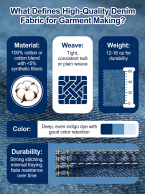
Denim fabric weight—measured in ounces per square yard (oz/yd²)—is a foundational indicator of durability, drape, and seasonal suitability. Per ASTM D3776, standardized tiers guide selection:
- Lightweight (8–11 oz/yd²): Maximizes breathability and comfort for warm-weather garments but shows lower abrasion resistance (≤15,000 Martindale cycles).
- Mid-weight (12–14 oz/yd²): Delivers optimal balance—enough structure for jeans with 20,000+ abrasion cycles and reliable drape.
- Heavyweight (15+ oz/yd²): Prioritizes rigidity and longevity (>30,000 abrasion cycles), though drape suffers—best for workwear or rigid selvedge applications. Weight deviations exceeding ±0.3 oz/yd² signal inconsistent weaving tension and compromise garment uniformity.
Twill Weave Tightness (Ends/Picks per Inch) and Its Effect on Fade Behavior and Dimensional Stability
Warp ends and weft picks per inch (EPI/PPI) directly govern indigo retention, shrinkage control, and fade behavior. Higher density—e.g., 78×56 versus standard 68×48—delivers:
- Enhanced dimensional stability: Shrinking less than 3% post-wash (per AATCC 135), ensuring pattern-cutting accuracy.
- Controlled fading: Resisting premature yarn breakage to produce even, vintage-style fades—not patchy degradation.
- Structural longevity: Withstanding five or more industrial washes without seam slippage, unlike looser weaves (<60 EPI), which may shrink up to 12% and fade inconsistently.
Critical Manufacturing Processes That Define Denim Fabric Longevity and Authenticity
Rope Dyeing vs. Slasher Dyeing: Indigo Penetration Depth, Fade Consistency, and Colorfastness Outcomes
Dyeing method critically shapes indigo depth, fade consistency, and colorfastness. Rope dyeing immerses yarns in multiple indigo dips, creating a ring-dyed structure with deep, long-lasting color and gradual, authentic fading. Slasher dyeing coats a sheet of yarn simultaneously—reducing time but limiting penetration to the surface layer. This results in weaker fade patterns and faster color loss. Rope dyeing achieves 70–80% indigo penetration versus 40–50% for slasher dyeing (industry data, 2023), making it the gold standard for premium denim. Its deeper indigo bond ensures enduring character through repeated washing—meeting consumer expectations for both longevity and aesthetic authenticity.
Table of Contents
- Understanding Denim Fabric Types and Core Performance Trade-offs
- Denim Fabric Composition: How Fiber Blend and Yarn Construction Drive Durability and Comfort
- Key Quantitative Metrics for Evaluating Denim Fabric Quality
- Critical Manufacturing Processes That Define Denim Fabric Longevity and Authenticity