 EN
EN

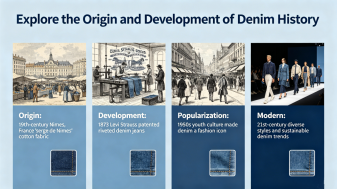
Denim Origins: French Textiles, Linguistic Roots, and Indigo’s Signature Hue
Serge de Nîmes and the birth of a durable twill fabric
In the late 17th century, weavers in Nîmes, France, developed a sturdy cotton twill fabric while attempting to replicate a local wool serge. Known as serge de Nîmes, its tight diagonal rib structure delivered exceptional durability and abrasion resistance—qualities that made it ideal for labor-intensive workwear. Over time, the name was shortened to “denim,” anchoring the fabric’s identity to its French city of origin.
How 'denim' (Nîmes) and 'jeans' (Genoa) evolved as distinct terms in denim history
“Denim” refers specifically to the twill fabric from Nîmes, while “jeans” traces back to Genoa, Italy—where sailors wore trousers made from a lighter, twill-woven cotton known locally as genes. Though both fabrics shared functional roots, their geographic origins shaped divergent linguistic paths: denim named the material; jeans named the garment. This duality reflects denim’s dual legacy—as a French textile innovation and an Italian garment tradition—that converged over centuries into the modern blue jean.
Indigo dye: functional necessity and enduring visual identity in denim history
Indigo dye—originally extracted from Indigofera tinctoria and other plants—gave denim its defining blue hue. In pre-industrial Europe, indigo was rare and costly, prized not only for its rich color but for its practical performance: it masked soil and wear on workwear while resisting fading through repeated laundering. That synergy of utility and aesthetics cemented indigo as inseparable from denim’s identity—a functional choice that became an enduring visual signature.
Industrial Innovation: The 1873 Invention of Riveted Denim Jeans
Levi Strauss & Jacob Davis — solving real-world wear problems during the Gold Rush
During the California Gold Rush, miners demanded clothing tough enough to endure grueling physical labor. Tailor Jacob Davis noticed how standard denim trousers failed at high-stress points—especially pocket corners and fly openings. His solution: copper rivets to reinforce seams and prevent tearing. Recognizing the commercial potential, dry goods merchant Levi Strauss partnered with Davis to scale production. Their collaboration wasn’t driven by fashion, but by a clear, unmet need for engineered durability in everyday workwear.
Patent #139,121: how copper rivets transformed denim from fabric to engineered workwear
On May 20, 1873, Strauss and Davis secured U.S. Patent #139,121 for “Improvement in Fastening Pocket-Openings”—the first legal recognition of riveted denim construction. The patent protected their use of metal rivets at key stress points, turning denim from a generic textile into purpose-built apparel. This innovation marked denim’s formal transition from commodity cloth to technical workwear, establishing structural integrity as foundational to its design philosophy long before it entered mainstream fashion.
Cultural Metamorphosis: Denim History as a Mirror of Social Change
1950s rebellion: Marlon Brando and James Dean cementing denim as anti-establishment symbol
Denim’s cultural pivot began in earnest in the 1950s, when Hollywood transformed utilitarian trousers into emblems of dissent. Marlon Brando’s leather-and-denim biker in The Wild One (1953) and James Dean’s brooding teen in Rebel Without a Cause (1955) projected raw, unfiltered defiance against postwar conformity. Their on-screen personas resonated deeply with youth audiences—and provoked swift institutional backlash. Schools and civic groups banned denim, inadvertently amplifying its symbolic power. Denim thus evolved from workwear into ideological armor: a quiet, wearable statement of nonconformity.
From counterculture uniform to global wardrobe staple (1960s–1990s)
By the 1960s, denim had become the unofficial uniform of protest and self-expression—from hippie flares and embroidered patches to Black Panther Party uniforms. Designers like Calvin Klein and Gloria Vanderbilt elevated it into high fashion in the 1970s, proving denim could carry both political weight and aesthetic prestige. By 1981, 96% of U.S. teenagers owned at least one pair of jeans (Cotton Incorporated), signaling full integration into youth culture. The 1990s expanded its range further: grunge’s deconstructed silhouettes coexisted with luxury labels’ premium washes and fits. Through decades of shifting values and aesthetics, denim retained its democratic appeal—equally at home on factory floors and fashion runways.