 EN
EN

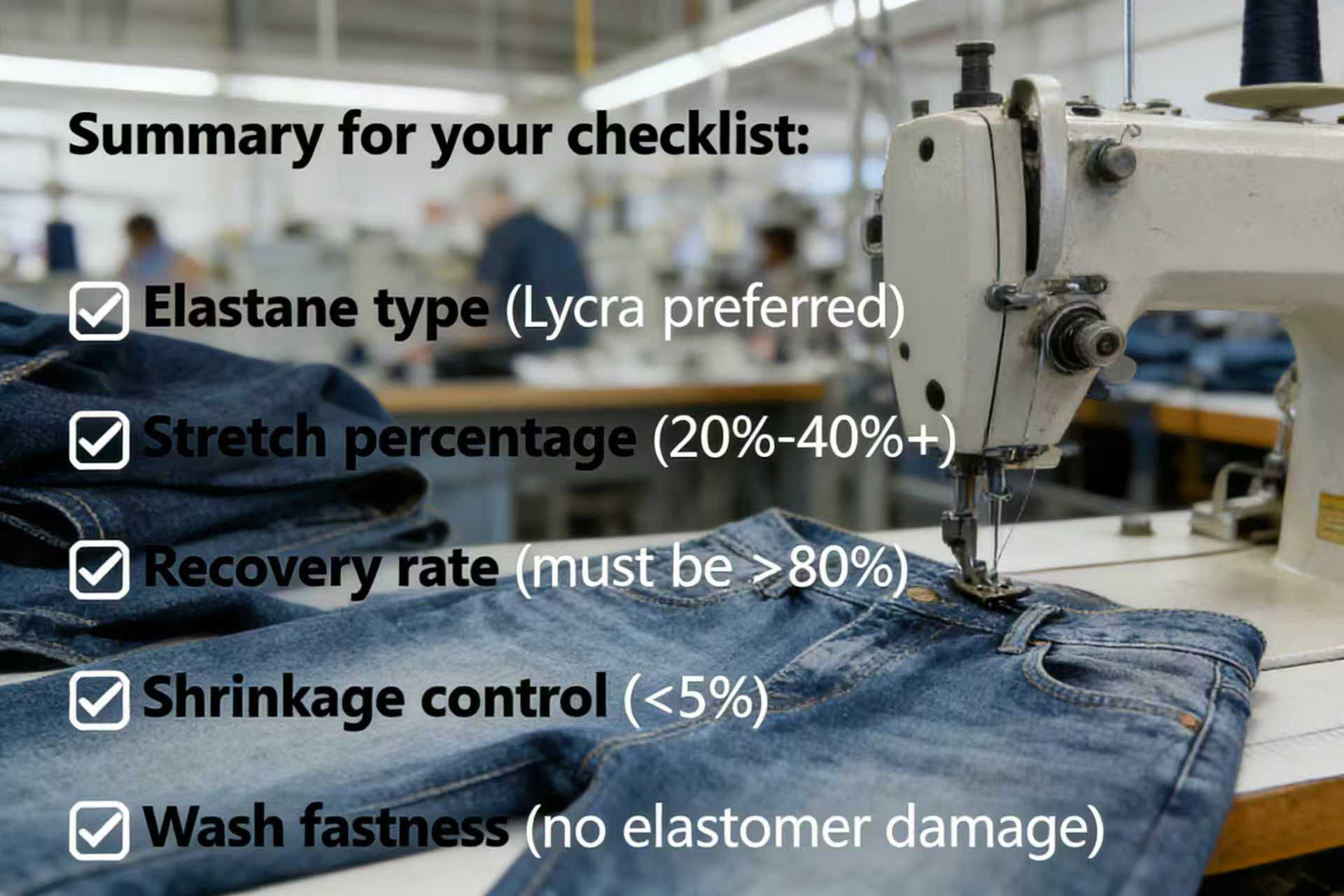
Core Performance Properties of High-Stretch Denim Fabrics
Elastane/spandex content and four-way stretch functionality
Denim with high stretch content depends heavily on how well elastane or spandex is mixed into the cotton blend, usually somewhere between 2% and 5%. This kind of balance lets people move freely without the fabric tearing or losing shape. According to what many manufacturers have found through testing, getting the right amount of spandex during the spinning process can actually increase how much the fabric stretches by around 25% to 40%, all while keeping it strong enough to hold up. When brands go beyond this range with higher percentages, sure they get better stretch, but then the fabric tends to breathe less well and starts breaking down faster after washing. Most top quality jeans end up settling around 3% to 4% spandex because that seems to work best for both comfort and durability in real world conditions.
Stretch recovery rate and resistance to permanent deformation
What really sets premium denim apart from regular stuff is how well it recovers after being stretched. The best quality fabrics bounce back to their original shape within half an hour after stretching, and they still hold onto at least 95% of their original size even after going through 5,000 tension tests according to ASTM standards. This kind of durability comes down to something called core-spun yarns. When manufacturers don't get the spandex tension right while weaving, the fabric loses around 30% of its recovery ability after just a few washes in commercial laundries. Garments that fail to recover properly end up with those annoying baggy areas around the knees and seat area over time. That's why it's so important for brands to test multiple samples thoroughly before making big production decisions based on fabric performance.
Fabric weight (GSM), durability, and end-use suitability
The grams per square meter measurement, or GSM, really affects how fabric functions and fits on the body. Lighter denim options typically fall between 8 to 10 ounces (around 270 to 340 gsm) and these are great for when someone wants something that moves well and drapes nicely over their curves. On the flip side, heavier denims weighing in at 12 to 14 ounces (about 400 to 475 gsm) stand up much better to wear and tear, making them ideal for work clothes or those tough outdoor jackets people need. According to Martindale tests, fabrics rated at 14 ounces containing just 3% elastane can handle about 40 percent more abrasion compared to their lighter counterparts. When shopping for materials, it's important to match GSM levels with what the finished product will actually face. Activewear needs those lighter weights so folks can move freely, but anyone working construction or doing serious fieldwork definitely wants something sturdier with higher GSM ratings and seams that won't give out under pressure.
Material Composition and Quality Assurance for Bulk Orders
Cotton-elastane blend ratios: Impact on hand feel, drape, and wash stability
How cotton and elastane work together affects both how clothes perform and how they feel against the skin. Most common mixtures contain between 92 to 97 percent cotton paired with 3 to 8 percent elastane. When there's more than 8 percent elastane in the blend, fabrics get better stretch and develop a smoother, silkier touch. However this comes at a cost since fabrics containing over 10 percent elastane tend to shrink or expand significantly more after being washed industrially compared to those with just 5 percent. On the flip side, blends with three percent or less elastane create a stiffer texture similar to traditional denim but sacrifice flexibility. For most premium clothing manufacturers, the sweet spot lies somewhere around 94 to 96 percent cotton combined with 4 to 6 percent elastane. This combination offers good shape retention with less than eight percent lasting deformation after twenty wash cycles, maintains a natural hanging shape, and keeps its form through repeated washing which is exactly what luxury fashion labels demand from their products.
AQL-based inspection, tensile testing, and stretch recovery validation protocols
Bulk procurement requires statistically rigorous quality assurance. AQL 2.5 sampling (per ANSI/ASQ Z1.4) should assess visual defects-including yarn irregularities and dye inconsistencies-across no more than 5% of rolls. Critical performance verification includes:
- Tensile testing: Minimum 30% elongation with ‰¤2% permanent deformation
- Cyclic stretch recovery: 5,000 cycles at 150N load (ASTM D3107)
- Wash stability: Residual growth measured after 10 industrial washes
Third-party lab data indicates 18% of commercial stretch denim fails cyclic recovery benchmarks. Contracts must require pre-shipment test reports confirming ‰¥92% recovery post-manufacturing-and mandate ongoing lot-level validation throughout production.
Supplier Selection and Contractual Safeguards for High-Stretch Denim Fabrics
Sourcing from mills vs. distributors: MOQs, lead times, and swatch-to-bulk consistency
Procurement strategy hinges on volume, timeline, and consistency requirements. Mills offer cost efficiency and vertical control but enforce high MOQs (often ‰¥10,000 yards) and longer lead times (8-12 weeks). Distributors provide flexibility-MOQs of 1,000-5,000 yards and delivery in 4-6 weeks-at a 15-30% price premium. Crucially, swatch-to-bulk fidelity differs significantly:
| Sourcing Channel | Color/Fabric Match Risk | Stretch Consistency Variance |
|---|---|---|
| Mills | 8-12% due to dye-lot shifts | ±5% recovery rate tolerance |
| Distributors | 3-5% with stocked inventories | ±2% recovery rate tolerance |
| Always insist on production validation swatches matched to bulk yardage-not showroom samples-to mitigate performance drift. |
Critical contract clauses: Stretch performance warranties, lot-to-lot uniformity, and defect liability
Contracts must codify technical expectations-not just aesthetics. Key enforceable provisions include:
- Performance warranty: Guaranteeing ‰¤20% elastane degradation after 50 industrial washes (AATCC TM61-2023)
- Uniformity clause: Limiting shade variance to ‰¤0.5 DEcmc and stretch recovery deviation to ‰¤3% between production lots
- Defect liability: Mandating replacement for critical failures-e.g., bagging knees (>15% residual elongation) or twist defects affecting >3% of shipment
Include destination-port third-party testing rights. Failure rates exceeding 5% should trigger full reimbursement for downstream production losses-not just fabric replacement.
Cost Optimization Strategies in Wholesale High-Stretch Denim Procurement
When looking at ways to cut costs smartly, what matters most is finding sources that match performance requirements instead of just going for the cheapest option. Most mills will offer around 15% off on bulk orders above 10,000 yards, but they usually want something in return like solid guarantees about fabric recovery after stretching. Getting multiple quotes from suppliers we've already checked out gives better bargaining power, particularly if there's real testing behind those claims. The payment schedule makes a big difference too. Many companies now go for 60 or even 90 days to settle accounts, which helps manage cash flow. Some also opt for consignment deals where materials stay on site until needed, cutting down on wasted stock. Don't forget to include those stretch recovery clauses in all contracts though. Fabrics need to keep at least 92% of their stretch after about 50 wash cycles according to lab tests from certified facilities. Shipping larger rolls whenever possible saves money on transportation expenses, sometimes as much as 18%. All these strategies work together to maintain healthy profit margins while still delivering the kind of quality customers expect from premium stretch denim products.
FAQ
What is the ideal elastane/spandex percentage for high-stretch denim?
Most top-quality jeans incorporate 3% to 4% spandex for optimal balance between stretch and durability without compromising fabric breathability.
How does GSM affect denim fabric?
Fabric weight measured in GSM affects flexibility and wear resistance. Lighter options (270-340 gsm) are suitable for activewear, while heavier fabrics (400-475 gsm) are better for durable workwear.
Why are cotton-elastane blend ratios important?
The blend affects hand feel, drape, and wash stability. A mix of around 94% to 96% cotton with 4 to 6% elastane is optimal for maintaining shape and minimizing deformation after washing.
What are the key elements of denim fabric contracts?
Contracts should include performance warranties, uniformity clauses, and defect liability, ensuring technical standards and accountability in production quality.