 EN
EN

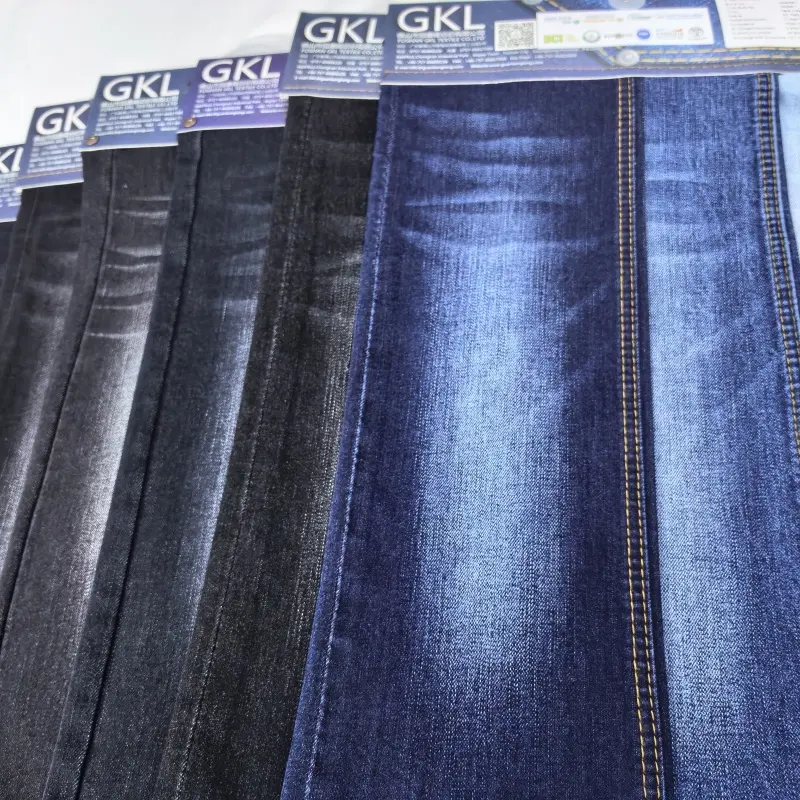
Optimal Wholesale Denim Fabric Weight for Fast Fashion Production
The weight of wholesale denim is a cornerstone of production efficiency: it shapes everything from cutting-room throughput to the final garment’s market appeal. For fast fashion brands, the 9–11 oz range stands out as the sweet spot that aligns drape, durability, and assembly speed.
Why 9–11 oz Denim Delivers the Ideal Balance of Drape, Durability, and Speed
Denim in the 9–11 oz per square yard range — classified as midweight — delivers controlled softness without sacrificing structure. It drapes fluidly enough for contemporary skinny, tapered, and cropped silhouettes yet retains sufficient body to hold crisp seaming and pocket definition. Its tensile strength resists tearing during high-speed stitching and withstands repeated wash cycles common in quick-turnaround collections — reducing in-process defects and post-sale returns. Crucially, this weight avoids the “cardboard” stiffness of heavier denims that slow operator handling, while remaining stable enough to prevent ply misalignment on automated spreaders and cutters. Industrial lockstitch and chain-stitch machines maintain consistent tension, and reduced needle deflection minimizes skipped stitches — sustaining line speeds without compromising seam integrity. The result is a fabric engineered for velocity: it moves seamlessly through cut-and-sew operations while delivering a garment with tangible quality and market-ready hand feel.
How Fabric Count (8–12 oz) Supports Rapid Cut-and-Sew Cycles Without Compromising Yield
Expanding the lens to the broader 8–12 oz window reveals strategic advantages in cutting consistency and material yield. At the lower end (8–9 oz), denim remains dimensionally stable on the cutting table — avoiding the slip and stretch that distort patterns in ultra-light fabrics. At the upper end (11–12 oz), it still cuts cleanly with standard straight-knife or CNC systems without excessive blade wear, eliminating frequent tool changes that interrupt flow. In sewing, this range supports standard DP×5 or DP×17 needles and No. 50–80 threads at peak machine speeds, with minimal thread breakage or skipped stitches. Yield gains are especially pronounced with sanforized or pre-shrunk fabric: residual shrinkage typically stays below 2%, allowing pattern makers to use tighter layout buffers and reduce fabric waste per lay. This predictability translates directly into more defect-free panels per roll, lower material cost per garment, and a faster, more reliable path from cut-table to shipment — precisely what fast fashion supply chains require.
Construction Standards That Enable High-Volume Wholesale Denim Output
Stitch Density Sweet Spot: 8–10 SPI for Seam Integrity and Assembly Line Efficiency
Stitch density is the critical lever balancing seam strength and manufacturing speed. Industry data shows that 8–10 stitches per inch (SPI) reduces thread breakage by 15% during high-speed assembly versus lower densities, while maintaining seam tensile strength between 35–40 N. At this range, needle heat stays below 180°C — preventing synthetic thread fusion — and skipping stitches remain under 0.5%, a threshold essential for bulk orders. Operators achieve 2,200–2,400 stitches per minute without rework, and denim’s 3/1 twill weave responds optimally: stitch length penetrates the warp without distorting the diagonal pattern. Factories standardizing at 10 SPI report a 12% reduction in repair time per garment and an 8% drop in machine downtime — measurable gains that keep output aligned with fast fashion timelines.
Chain-Stitch vs. Lockstitch: Selecting the Right Seam Type for Bulk Wholesale Denim Orders
Choosing the right seam type is not just technical — it’s operational. Chain-stitch (ISO 401) enables speeds exceeding 6,000 stitches/min and offers 30–50% elongation, making it ideal for side seams, hems, and waistbands where movement and flexibility matter. A 2022 lean manufacturing study found using chain-stitch for 80% of seams cut total assembly time by 19%. Lockstitch (ISO 301), meanwhile, delivers superior seam strength (35–40 N) and rigidity — critical for high-stress zones like the crotch, back rise, and pocket reinforcement. Its lower thread consumption also improves cost efficiency. The optimal strategy for wholesale denim is dual: deploy chain-stitch for non-critical seams to maximize speed and comfort, and reserve lockstitch for structural reinforcement. This approach maintains durability where it matters most, simplifies thread inventory, and eliminates trade-offs between throughput and quality.
Quality Control Benchmarks for Wholesale Denim in Fast Fashion Supply Chains
Three Essential QC Checks: Yarn Evenness, Warp/Weft Alignment, and Back Pocket Reinforcement
In fast fashion, where lead times are compressed and volumes high, proactive quality control prevents costly downstream failures. Material defects drive 39.3% of customer claims — making rigorous incoming inspection non-negotiable. First, yarn evenness: inconsistent yarn thickness causes weak spots, streaking after washing, and unpredictable dye uptake — all of which compromise hand feel and drape. Measure weight variation across the roll; deviations exceeding 5% signal performance risk. Second, warp/weft alignment: even 2% skew disrupts pattern cutting, reduces yield, and triggers cascading errors in high-volume runs — so a formal skewness test must be part of every incoming inspection. Third, back pocket reinforcement: this high-stress zone demands scrutiny. Verify stitch density (8–10 SPI) and bartack strength; a pull-test must confirm resistance to at least 15 kg of force. Automating these checks significantly reduces human error — responsible for 63.2% of sewing faults — and embeds quality into the earliest stage of production.
Finishing and Sourcing Strategies That Align Wholesale Denim with Fast Fashion Timelines
Pre-Shrunk vs. Sanforized Denim: Prioritizing Consistent Yield and Wash Predictability
Sanforized denim — processed through controlled compressive shrinkage — limits post-wash shrinkage to under 1%, compared to 3–5% for untreated fabric. This precision safeguards garment dimensions and yield across large wholesale orders. For fast fashion brands pairing denim with trend-driven finishes — like enzyme washes, preferred by 65% of consumers for their soft hand — dimensional stability is non-negotiable. Unstable base fabric leads to distortion, fit inconsistencies, and higher return rates. While “pre-shrunk” denim often implies only a basic wash, it may still retain 2–3% residual shrinkage. Sanforization, as a mechanical standard, ensures uniform behavior yard-for-yard — enabling tight pattern grading, minimal fabric waste, and fewer fit-related reworks. This reliability accelerates the entire production timeline, from sourcing to shelf, making it the definitive choice for high-volume, fast-turnaround denim programs.
FAQs
What is the importance of choosing the right denim weight for production?
The right denim weight, such as the 9–11 oz range, ensures a balance between drape, durability, and production efficiency. It helps improve both garment longevity and production speed, critical for fast fashion brands.
Why is stitch density important in denim manufacturing?
Stitch density, ideally 8–10 SPI, ensures optimal seam strength while maintaining high manufacturing speeds. It reduces thread breakage and machine downtime, resulting in faster, more efficient production cycles.
What are the differences between chain-stitch and lockstitch in denim production?
Chain-stitch offers high speed and flexibility, suited for non-critical seams like hems and waistbands. Lockstitch provides superior strength and durability, ideal for high-stress areas like crotch seams and pocket reinforcements.
What quality control checks are essential for wholesale denim?
Key QC checks include yarn evenness to prevent weak spots, warp/weft alignment to avoid pattern distortions, and back pocket reinforcement to ensure durability.
Why choose sanforized denim over pre-shrunk denim?
Sanforized denim offers better dimensional stability with less than 1% shrinkage, which ensures consistent garment fit, reduces fabric waste, and accelerates production timelines compared to pre-shrunk fabric.
Table of Contents
- Optimal Wholesale Denim Fabric Weight for Fast Fashion Production
- Construction Standards That Enable High-Volume Wholesale Denim Output
- Quality Control Benchmarks for Wholesale Denim in Fast Fashion Supply Chains
- Finishing and Sourcing Strategies That Align Wholesale Denim with Fast Fashion Timelines
-
FAQs
- What is the importance of choosing the right denim weight for production?
- Why is stitch density important in denim manufacturing?
- What are the differences between chain-stitch and lockstitch in denim production?
- What quality control checks are essential for wholesale denim?
- Why choose sanforized denim over pre-shrunk denim?